God’s Word provides a blueprint for how to transform America and the nations. The Bible addresses all of life, from personal and family matters to economic and civil affairs. A Biblical overview of 21 areas of life is presented. Talks contain many historical examples of how Christianity has brought transformation to all spheres of life.
Sessions include:
Building Nations with the Blueprint of God’s Word;
Nation Building for a New World:
Principles from the United States’ Model of Government and Liberty;
Seven Ideas that Have Transformed the World;
The Economy from a Biblical Perspective.
Instructor: Stephen McDowell
**Click to Choose Audit**
Statism: the Golden Calf of the Modern World
Israel worshiped a golden calf. Many Christians in the world today, especially the western world, worship a golden calf as well. But this is not a physical golden calf. It is the golden calf of socialism, the god of statism. This false god is one of the greatest threats to Christianity in the 21st century. In recent elections we have seen people tearing off their “golden rings” and clamoring for such a god. To those who worship this golden calf it seems to be a good god that will do good things for them. It promises them provision, security, comfort, and much more. Beware! This god will gradually consume you, your family, your business, and your freedom.
This booklet exposes one of the greatest threats to Christianity today and one of the greatest problems the world faces. Applying the ideas presented here would turn America around.
Author: Stephen McDowell
Providential Perspective Series – 1
PP01
This course provides an excellent introduction to a Biblical philosophy of government, law, and politics.
Sessions include:
1. The Ten Commandments: the Fundamental Law of God (2 sessions)
2. Liberty: the Fruit of Biblical Jurisdictional Authority
3. The Fundamental Principles of Christian Nations
4. The Advance of Liberty in History.
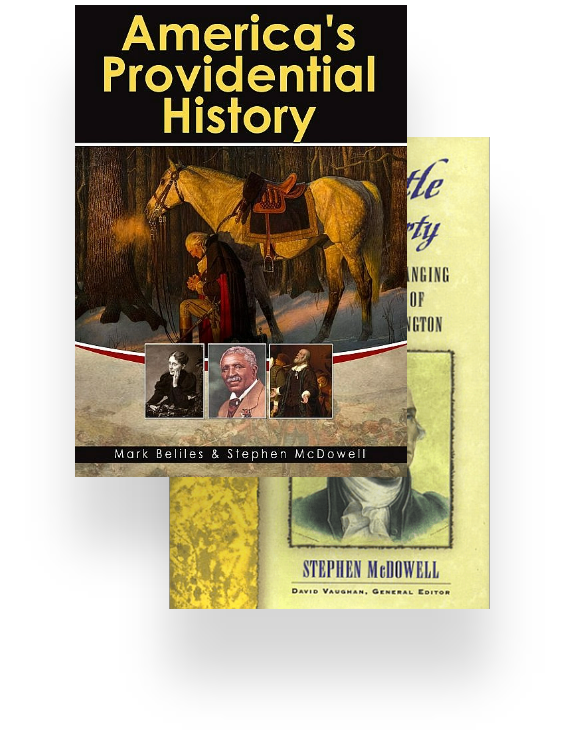
5. America’s Providential History.
Instructor:Stephen McDowell
6 one-hour sessions on DVD.
(Course is also available on CD, & Audio tape.)
Course No.: STA01
Choose Credit if you are enrolled in the Biblical Worldview University and you will receive credit towards your Providence Foundation degree.
**Click to Choose Audit**
This one hour presentation at The Assembly Conference in Virginia Beach, April 26-28, 2007, presents the story of the Christian influence in the founding of the first permanent English settlement in America. Stephen McDowell looks at Rev. Richard Hakluyt, the man most influential in English colonization in the new world, and his motive “to inlarge the glory of the gospel.” Mark Beliles presents God’s hand in the events in the first years of Jamestown, Christianity in the early official documents, and how the early settlers fulfilled their desire to propagate the Gospel. This presentation also contains a 5 minute segment of a new film in production on the American Dream; plus, the song, “Destiny, Come Follow Me(Jamestown)” by John Phillips.
DVD06
60 minutes
- God’s Sovereignty over the Nations God governs in the affairs of His children, of the ungodly, and of nations. God raises up nations and they have responsibilities to Him. In governing in the affairs of men, God brings about a preparation of His people, revelation of His power and person, and consummation of His purpose. An understanding of God’s sovereignty will produce a great confidence in us.
- How to Disciple the Nations This tape examines what a Christian nation is and what is needed to disciple the nations. It looks at key civil teachings of Jesus necessary for the discipling of nations including jurisdictional authority, the Biblical conception of society, three divine institutions and their purposes, and the religious foundation of all nations. Education is a key element in discipling the nations. The price we must pay to disciple the nations is great, as evidenced by William Penn.
- Fulfilling the Cultural Mandate A look at how men of God have helped establish God’s Kingdom in the nations, including Samuel F.B. Morse, George Washington Carver, Cyrus McCormick, St. Patrick, and more. The cultural mandate calls us to use all our resources to express His image and likeness on the earth. Fulfilling this mandate requires us to discover truth through sciences, apply truth through technology, interpret truth through humanities, implement truth through commerce and social action, transmit truth through education and arts, and preserve truth through government and law.
- The Influence of the Bible on the Development of American Constitutionalism Christianity is the source of civil liberty and American constitutionalism. This tape examines how civil liberty is a product of the Bible in the hands of the people. It looks briefly at many significant civil documents of liberty in British and American history, including Patrick’s Liber, the Magna Charta, Charter of Virginia, Mayflower Compact, Fundamental Orders of Connecticut, “Blue Laws” of New Haven Colony, the Declaration and U.S. Constitution, and more.
Instructor: Stephen McDowell
4 one-hour sessions on DVD.
Course No.: STA02
**Click to Choose Audit**
Jesus or Mohammad: Who brought liberty to the world?
Islam is one of the two greatest external threats to Christianity in the twenty-first century. Statism is the other. Though not as old as statism, Islam has been at war with Christianity since its inception by Mohammad in the seventh century. This booklet provides a brief overview of the history of Islam and its teachings in order to give proper context to this very grave danger that the free world and the Christian faith faces. The historical overview of Islam presented here—which includes the Crusades, important battles stopping Islam’s spread throughout Europe, and Muslims’ influence in American history—reveals that its aggressive expansion and conflict with Christianity are normal. The ideological and worldview comparison of Christianity and Islam shows that Christianity produces liberty, while Islam brings oppression. Many questions are also answered, such as: Is Islam a religion of peace? How should America deal with Islamic terrorists? What can we do regarding the threat of Islam to the Christian faith? Finally, there is good news: God is moving among many Muslims to bring them to Christ.
Instructor: Stephen McDowell
Runtime is one hour and 13 minutes. 1:13:22
Examples of Joseph Lister & John Wanamaker
Joseph Lister & John Wanamaker transformed medicine and business by applying Biblical principles in their divine occupations. Most Christians are not called to the pulpit ministry; rather most Christians are called to the marketplace. Kingdom businesses and our calling in the marketplace are a key part of our taking dominion over the earth. The stories of Lister and Wanamaker will inspire us toward this end.
Author: Stephen McDowell
Providential Perspective Series – 5
28 pages, paperback PP05
Thomas Jefferson produced two abridgements of the Gospels with two different purposes. He envisioned his 1804 “cut to paste” abridgement (46 pages) as a mini-Bible and “Collection for the Indians.” He originally hoped to publish it as a manual in different Indian dialects as a concise summary of the moral and doctrinal precepts of the Bible for Native Americans on the frontier. However, his 1820 expanded abridgement (82 pages)—in Greek, Latin, French and English—was for his personal study.
Jefferson’s 1804 White House “wee little book” has never been found except for the Title Page, Table of Texts, and two KJV Bibles he used to clip Scriptures into a blank notebook.
Dr. Judd Patton, Professor Emeritus at Bellevue University, has re-constructed President Jefferson’s 1804 abridgement highlighting: the words of Jesus in red-letters; the moral and doctrinal precepts of Mr. Jefferson’s work; seven rare, historic facsimiles of Jefferson’s Title Page, Table of Texts and 1791 Bible; and three scholars who explain the context of Jefferson’s work for Native Americans, that calls into question the common but erroneous perceptions associated with the “Jefferson Bible.” The book is dedicated to Native Americans and is a must read for American patriots desiring to understand Thomas Jefferson’s classic work in early American religious history.
Editor: Judd W. Patton
Pages: 242
Jesus or Mohammad: Who brought liberty to the world?
Islam is one of the two greatest external threats to Christianity in the twenty-first century. Statism is the other. Though not as old as statism, Islam has been at war with Christianity since its inception by Mohammad in the seventh century. This booklet provides a brief overview of the history of Islam and its teachings in order to give proper context to this very grave danger that the free world and the Christian faith faces. The historical overview of Islam presented here—which includes the Crusades, important battles stopping Islam’s spread throughout Europe, and Muslims’ influence in American history—reveals that its aggressive expansion and conflict with Christianity are normal. The ideological and worldview comparison of Christianity and Islam shows that Christianity produces liberty, while Islam brings oppression. Many questions are also answered, such as: Is Islam a religion of peace? How should America deal with Islamic terrorists? What can we do regarding the threat of Islam to the Christian faith? Finally, there is good news: God is moving among many Muslims to bring them to Christ.
Endorsement:
“The Threat of Islam to Liberty and Christianity is a fine piece of scholarship that merits the widest distribution possible. It is a first rate summary of the history and interaction of Christianity and Islam. Your handling of the Crusades is the most succinct I have read anywhere, ‘The Crusades were not the brainchild of an ambitious Pope or rapacious knights but a response to more than four centuries … of Muslim conquests.’” – Gen. Jerry Curry (retired)
56 pages, paperback, PP16
Authors:Stephen K. McDowell
Jesus reiterated what is taught throughout the entire Bible: that God’s Law/Word, which is summarized by the Ten Commandments, contains principles that, if obeyed, produce life — life for men and nations — but if ignored, produce death. He said: “Do this [keep the commandments] and you will live.” America’s laws were based upon God’s higher law. This higher law, as summarized in the Ten Commandments, used to be taught to all Americans, was greatly revered, and all looked to obey it. Today, few obey, revere, or even know His commands.
Many people are doing all they can to remove any vestige of His law from our nation, claiming they are a great detriment to society. In 1980 the Supreme Court ruled in Stone v. Graham that the public schools of Kentucky could not display the Ten Commandments on the walls. The Court said: “If the posted copies of the Ten Commandments are to have any effect at all, it will be to induce the school children to read, meditate upon, perhaps to venerate and obey, the Commandments.” Just imagine if our children obeyed the Ten Commandments. Some may consider this dangerous, but in reality this would solve many of our problems. About 1.7 million Americans are behind bars today — 1 in every 155. To learn to not steal or murder might not be too bad an idea to help deal with this problem. This booklet shows the importance of the commands for us today and gives an overview of the them, highlighting the positive corollaries of the negative laws.
24 pages, paperback B11
Author: Stephen McDowell