





YOUR CART
- No products in the cart.
Subtotal:
$0.00
BEST SELLING PRODUCTS


$6.95



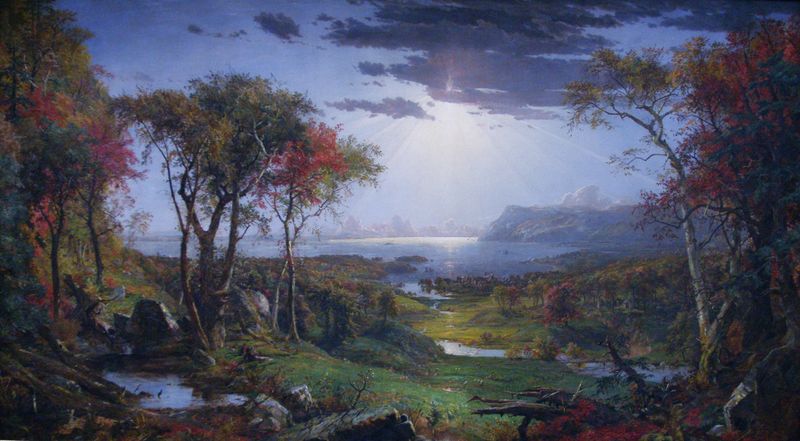
The Hudson River Painters were biblical artists. This early 19th century school of American landscape painters sought to express the beauty, light, and truth of the Creator through capturing His creation on their canvases. Their motivation and work are presented well in the book Knights of the Brush, The Hudson River School and the Moral Landscape by James F. Cooper.
Most of this booklet, American Landscape Painters, contains excerpts from Knights of the Brush, which I believe is the best way to introduce you to the story of these important painters. I have included pictures of several paintings by these artists, but I would encourage you to view and learn about more of them in Cooper’s book. Many original paintings of these landscape painters can be seen in two museums in Washington, DC: The National Gallery of Art and the National Portrait Gallery.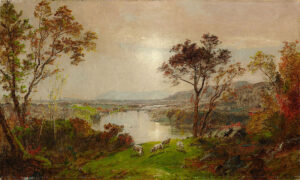
American painting has suffered the same fate as American history – its Christian and moral foundations have been covered up, distorted, and lost. This is especially evident with the landscape painters of the nineteenth century. The prominent painters of the Hudson River School, covering the years 1825-1860, included Frederic Edwin Church, Thomas Cole, Jasper Francis Cropsey, and Asher Brown Durand. The Christian nature of these painters is presented in the following excerpts from Knights of the Brush, The Hudson River School and the Moral Landscape, intermixed with remarks by the editor. (All portions in quotation marks are from Cooper’s book.)
The work of these painters is summarized on the jacket cover:
“For these painters there was a moral purpose in being an artist; art was a sacred obligation. Perhaps not since the Middle Ages had a school of art infused such religious certitude into works of art. William Cullen Bryant wrote, ‘The paintings of Cole are of that nature that it hardly transcends the proper use of language to call them acts of religion.’”
“The paintings of the Hudson River School — idealized, transcendent, and poetic interpretations of nature — are an extraordinary fusion of Christianity, Greek and Roman culture, and American democracy. They are filled with light, the most obvious manifestation of God’s presence, expressing man’s harmony with nature, seen as a second chance for mankind in the new Eden of the American wilderness.”
These were not religious paintings of obvious religious themes, like many from the Middle Ages, but Christian paintings, reflecting God’s nature and light in His creation through the excellence of the scenes, styles, and techniques.
In the modern relativistic world, “Beauty [has] suffered the same fate as morality.” Just as there is no standard for moral behavior, there is no standard for beauty when looking at art — beauty is only in the eye of the beholder. The random strokes of a monkey on a canvas can be just as beautiful as the masterful brush of Da Vinci on the Last Supper. It all depends on who is evaluating them. The recent taxpayer funded work that demeaned Christ can be art to some modern subjective viewers, for there is no objective standard by which to judge beauty or art.
However, a secular humanistic worldview is not founded upon truth and cannot sustain itself. Thus, beauty and goodness continue to be acknowledged. “Beauty…has survived its harshest critics.” “Goodness, beauty, and truth have thus outlasted the critique of those that constituted modernism.”
Even where obvious beauty exists to all but the most deluded viewer, as in the marvelous landscape paintings of the Hudson River School, modern art critics have rewritten the Christian and moral motivation of these American artists, ignoring the central motivation of their work and presenting them to people today as racists and imperialists. Just as there has been a rewriting of American history, there has been a rewriting of American art history.
“The arts are the expression of the divine in man. The leaders of the Church recognized that fact centuries ago. They introduced into the Church the fine arts and music, because they realized that the written or spoken word alone cannot compel that deep veneration for the Divine.”
“Nineteenth-century artists saw the sacredness of the land, its beauty, its promise, its virtues, its covenant with God.”
“For the Hudson River School painters there was a moral purpose in being an artist. Art was a sacred obligation.” This is in great contrast to our culture today where “beauty, morality, and religion are rejected as criteria for art.” As one man said in a speech at the University of Texas, “beauty…is irrelevant to the aims of art.” Post-modern art scholars have not only attacked the values of beauty and virtue, but are using major American institutions to libel the 19th century American artists as “racist” and “imperialist.”
“Rejection of aesthetic standards came with the 1960s. With it has come the rejection of all standards, first in the arts, then quickly in every other activity, including education, religion, business, and politics.”
“To approach the Hudson River School painting properly is to see it the way the artists intended us to see it. Beauty, virtue, and spirituality are instantly recognizable as the epistemology of these works.”
The Hudson River Painters are the fruit of the American Christian Republic. Art, like every other field, reflects the Christian foundation of America; but art also helps to preserve and propagate the Christian seed.
“Moral, spiritual people are capable of creating great works of art and architecture. Debased people — under totalitarian governments — are not. Beauty, excellence, quality, and craft are manifestations of, a litmus for, a moral people. Sometimes it is as simple as acknowledging that beauty exists within a work of art. Beauty restores our faith in God. Creating beauty restores our faith in the future.”
“This book is about seeing, about a group of nineteenth-century American artists who saw the world through a profoundly religious lens, revealing a landscape illuminated by a deep spiritual light. That lens was ground to perfection by succeeding generations of pilgrims, theologians, patriots, pioneers, and Founding Fathers, who beheld a transcendent image of America in harmony with nature. Theirs was a profoundly Christian view of America, as a ‘shining city upon the hill,’ ‘a beacon for all mankind,’ and ‘a fitting place for God.’ The founders of the Hudson River School, America’s first indigenous school of painting, were religious, moral men.”
The Hudson River School reflected the Biblical morality and worldview of the founding generation of Americans. They “saw the American landscape as blessed by God.” These artists believed that “the arts play a critical role in a civilization, not only in defining and disseminating core values, but also as a barometer of moral character.” Jasper Cropsey wrote in 1846: “No moral and refined work of art could be produced by an immoral man.” For Cropsey, “the artist was a knight who wields not a sword but a brush in his pursuit of spiritual and moral perfection.” He saw himself on “a holy quest,” involved in “spiritual warfare.”
Movie makers today are like these artists of earlier centuries. In the 1800s people paid money to see paintings, which would at times be displayed in traveling exhibits. Before the invention of the camera there were few pictures, so they had a great effect on the viewers. “There was a moral purpose in being an artist.” “One was called to art much as one was called to the ministry. It became a sacred obligation. And nowhere was the obligation more important than in the new republic.”
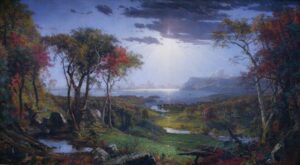
“Genesis instructed these nineteenth-century artists that, when God created the Earth, Seas, Heaven, Sun, Moon, Man, Woman, and all living and growing things, he saw that it was good: ‘And God saw the light, that it was good: and God divided the light from the darkness.’ This process of creating and seeing was repeated each time, until at the end of the sixth day, ‘God saw everything that he had made, and behold, it was very good … and he rested on the seventh day.’ The human ability to see, to judge, to comprehend the universe, was understood to be part of the divine spirit. Seeing implies an aesthetic function, but it was far more than that for these artists. Ruskin wrote that ‘the greatest thing a human soul ever does in this world is to see something… to see clearly is poetry, prophesy, and religion, — all in one.’ We are drawn to the artists of the Hudson River School because they enable us to see what they saw with fresh eyes: the beauty of nature, the glory of God, and the virtue of America.”
“This study addresses what has been too often ignored, deemed irrelevant or archaic, the religious, moral, and aesthetic sensibility that underlies the works of the artists of the Hudson River School. This involves reconstructing an aesthetic tradition that many assume never existed, that of Protestant Christianity.” Contrary to the thinking of many today, the Puritanism and Calvinism of early America were not hostile nor indifferent to the arts. “Protestant theology had rich implications for the way art was created and understood.” In fact it was this Christian worldview that produced not only civil, religious, and economic liberty in America, but also the liberty and atmosphere in which art and beauty advanced.
“Beauty for the Hudson River School painters was not mere aestheticism but a glimpse of God’s glory. They believed that the glory of God shines through the beauty of nature… Cropsey writes: ‘The voice of God came to me through every motionless leaf … on every blade of grass … in every breath of air…. in all these things I could see the beauties of holiness and the greatness of the Lord.”
Early leaders and Presidents in America saw the arts as immensely important because they served “to elevate the soul” and promote morality. Samuel F. B. Morse (1791-1872), founder of the National Academy of Design (and inventor of the telegraph) said: “Art … is one of the greatest correctors and promoters of refinement.”
The writings of Jonathan Edwards not only inspired the First and Second Great Awakenings, but also “changed how Americans and particularly artists of the nineteenth century saw the American continent. Edwards believed that the ‘beauty of holiness’ had its own aesthetics. The true believer, Edwards wrote, loves the ‘loveliness’ of the moral excellency of divine things for its own sake. This beauty resides in the object, Edwards believed, not in the beholder. He maintained that only the ‘purified’ eye can perceive it…. ‘Whoever cannot comprehend it has no indwelling of the Spirit.’”
“The ‘purified’ eye was provided by Thomas Cole, a young English artist” who founded the Hudson River School some years after arriving in America in 1818. These artists recognized, like the founding fathers of America, that “the social, moral, and civic order of the new republic also required a spiritual order.” It was in fact this spiritual order, originating in the Christian faith, that gave birth to the American Republic and would be necessary to sustain it. These painters saw that their work would help in promoting the Christian virtue needed to support liberty. The Hudson River School artists “believed beauty was a manifestation of virtue.”
“The virtue of Hudson River School painting is manifested not only in its iconography, but in its aesthetic order. Beauty serves holiness. The beauty of nature manifests God’s presence. Thus painters, like ministers, practice virtue through the act of painting. Painting can be seen as a kind of active prayer.”
“Almost every household in nineteenth-century America owned at least two books: the Bible and John Bunyan’s Pilgrim’s Progress. Thomas Cole, Jasper Cropsey, and Frederic Church illustrated Bunyan early in their careers.” Knights were often used in these illustrations, as well as in many of their later paintings. These represented spiritual battles that we all face in our journey of life.
“Cropsey’s knight of the brush is not so much a medieval figure as a Protestant allegory for spiritual renewal…. The knight suggests the high sense of mission and moral responsibility that motivated these artists. It also has connotations of what the Calvinists called ‘spiritual warfare,’ the notion that the Christian life is one of struggle and pilgrimage.” The Hudson River painters expressed “the ideas of chivalry — God, nation, honor, beauty — in their art.”
“For Americans of the early nineteenth century, art was inextricably bound up with its moral and social functions. Thus Cropsey can write without reservation that a moral art cannot be created by an immoral man. Durand can avow that artists ‘cannot serve God and mammon’ and perceive that the pursuit of money is ‘one of the principal causes operating to the degradation of art.’”
“Americans today might find relevance, reading Pilgrim’s Progress, in Christian’s reply, when he is asked whether he thinks about his homeland: ‘Yes, but with much shame and detestation … [for] now I desire a better country, that is, a heavenly one.’ The Hudson River School artists shared a common feat that something dreadful might happen to America if it strayed from the ‘heavenly’ path.… Nineteenth century artists were regarded by their contemporaries as knights embarked upon a moral mission. The public, today, is more likely to regard contemporary artists as destroyers.”
“Art, in its true sense, is, in fact, man’s lowly imitation of the creative power of the Almighty.” – Thomas Cole
“The artists of the Hudson River School believed America was the ‘new promised land,’ blessed by God. Their paintings — filled with light — reflect deeply held religious convictions, expressing man’s harmony with nature. Light is the most obvious manifestation of God’s presence. Hudson River School art is not simply about ‘pretty pictures’; it is about renewal, a second chance for mankind in Eden.”
“The wilderness of the American continent at the beginning of the nineteenth century presented a great mystery, even in its size. There were many dangers and hardships for the early settlers. The artists of the Hudson River School painted this wilderness as a ‘fitting place for God,’ a land for brave, religious God-fearing, freedom-loving men who were awed by the sublime beauty of God’s handiwork. Many American pioneers, farmers, builders, and entrepreneurs carried this vision of a beautiful, blessed landscape in their minds as they pushed across the frontier. The art, the literature, the culture of the time enabled them to see as clearly as if they were in church listening to a great sermon.” In one of his paintings, Durand “depicts nature as a great cathedral. The function of art…is not merely to render religious subjects…. Art assists religion by pursuing beauty.”
“Beauty, as a way to God, was the guiding principle for nineteenth-century American landscape painters. For the Hudson River artist, the ability to see the American landscape filled with God’s light was not picked up casually or even through diligent study. Rather, it was the result of a spiritual transformation. Such transformations had occurred earlier on a vast national scale” in the First and Second Great Awakenings. These awakenings had a great impact in the entire life of the nation, including art. “Following the Second Great Awakening, landscape painting became ‘holy text’ and ‘revealed truth.’”
“The Bible on the table and the landscape print on the wall became ubiquitous cultural symbols in almost every American home…. Art was the vehicle to celebrate God and the American wilderness as the new Eden…. Cole believed the artist’s task was to use landscape to reveal a spiritual vision:…‘he wished his canvases at the same moment to speak a language eloquent of God and man, and human life.”
“Beauty is not aestheticism. It is not an aim in itself. It is a glimpse of God’s glory…. People are thirsting for beauty and for what they rightly feel is behind beauty: the glory of God revealed to us.” – Christoph Schonborn
“Art assists religion by pursuing beauty: ‘That which the artist should aim at is the perfect perception of the Divine Beauty, the witness and seal of the hand of God in all His works.’… If the art of a nation is beautiful, it is because the nation is noble. If the arts are ugly, society is immoral…. [W]orks of art reflect the spirituality and moral character of an artist, which in turn reflect the spirituality and character of the greater society…. Beauty, in itself, whether that of God’s creation or a work of art, points to God…. [T]he religious significance of art lies not so much in its content but in its form, not in the overt theme but in its aesthetic effect.”
“In nature, Cropsey looked for the word of God to man, a natural revelation of great truths and transcendent realities that would be uncovered by close observation. ‘I think it is a mistaken view,’ wrote Cropsey, ‘that Nature should not be copied too closely…. Men forget they would have known little artistically had not Nature been before them, from whence to educate the eye and receive in great measure their powers of discrimination.’”
“Durand wrote that ‘the true province of Landscape Art is the representation of the work of God.’… Durand, who would become the theologian of the Hudson River School, decided not to become a minister of the church, but to express his faith through painting.”
“These artists were not painting pretty pictures of the American wilderness to charm patrons or, as we are informed by revisionist historians, painting advertisements and propaganda for a wealthy class intent on Manifest Destiny and subjugating races of indigenous and transplanted peoples. Their intent was to preach a sermon.” In America in the “early nineteenth century…art, far from being morally neutral or subversive, was seen as a powerful moral force. These artists saw themselves not as alienated bohemian rebels, nor as entertainers of the bourgeoisie, but, in effect as ministers, employing their talents in the cause of moral reform and spiritual illumination.… They associated their moralistic view of art with democracy, while consigning immoral aestheticism to the tyrannies of Europe.”
“Aesthetic relativism strikes many Americans as less critical than moral and intellectual relativism. Yet it may well be that the loss of beauty has precipitated the loss of the other absolute values. The arts are crucial to regaining the civic virtue and spirituality…. For Cole, the moral and aesthetic were indistinguishable…. [He] believed in uniting the ethical and the aesthetic. ‘There is in the human mind,’ Cole wrote, ‘an almost inseparable connection between the beautiful and the good.’”
“Ruskin taught that nature was itself the voice of God. Art, he said, was simply the advertisement for the ultimate truth. An artist was one who could perceive spirituality. A work of art carried its spiritual message not only through its subject matter, but through its very form and texture.”
“Landscapes of the Hudson River School remind us that aesthetic values are eternal, that they are an intrinsic part of our national language. Beauty in itself, whether that of God’s creation or of a work of art, points to God. The idea that the arts and artists serve a spiritual and moral purpose is central to Hudson River School painters. Their art reveals the national character of nineteenth-century America: their reverence for nature and light, for hard work; their love of sublime landscape; their faith in truth, beauty, and order and in America’s Manifest Destiny; their perception that the land was a ‘fitting place’ for communion with God.”
“American nineteenth-century landscape painting during the years 1830 to 1860 was inextricably tied to Protestant theology. Church publications regularly discussed the arts, and the preeminent American arts journal of the time, The Crayon, treated the subject of religion and the arts as a central theme, beginning each issue with a biblical text on its cover page. The Hudson River School artists were deeply religious. Thomas Cole was an evangelical Christian who later became a high church Anglican. Frederic Church came from a long line of Puritans and was himself a staunch Congregationalist. Jasper Cropsey was active in the Dutch Reformed Church. Asher Durand, who would become the theologian of the Hudson River School, decided not to become a minister of the church, ‘the better to indulge reflection unrestrained under the high canopy of heaven.’ During its golden age the Hudson River School produced a unique blend of religion, beauty, virtue, nature, and nation.”
“The artists of the Hudson River School perceived aesthetics to be an attendant sign of sincere Christian faith…. The spiritual landscapes created by the Hudson River School artists…idealized, transcendent, and poetic interpretations of nature, colored by religious, spiritual, moral, and aesthetic beliefs…. Their intent was to present a view of the physical world shaped by an unseen moral and spiritual order. The most obvious manifestation of this moral and spiritual order for Americans confronted with a vast, untamed wilderness was nature itself. A second manifestation was light. A third manifestation was beauty. Other manifestations included order and harmony. Nature, light, beauty, order, and harmony did not exist for their own sake but, as Cole wrote, were manifestations of a higher reality.”
“[T]he Hudson River School artists were passionately and sincerely religious. They believed that beauty was not only an aesthetic vehicle for the truth, but that beauty was part of the truth. Asher Durand…wrote: ‘The true province of Landscape Art is the representation of the work of God in the visible creation, independent of man, or not dependent on human action.’ Their perception of art was similar to Jonathan Edward’s perception of Christianity. A good painting, like a good Christian, had observable traits.”
“Hudson River School art evolved out of the tradition of Jonathan Edwards, who wrote about the need to recognize the true believer through sensory perception. God, the first art critic, ‘judged’ his work, Creation, by seeing. The Bible does not say he reasoned, deduced, or knew. Genesis says God saw that the creation of light, earth, and all living things was ‘good.’ The ability to see the good, for these artists, implied recognition of the beautiful. They responded to the good as naturally as they responded to beauty.”
The Hudson River Painters had a vision to transmit God’s paradise and preserve it through Biblical renewal in all spheres of life. They were aware of the gradually encroaching secularism in western civilization, especially seen in European art and culture. They hoped to keep this destructive force from overtaking America, not by using all their energy to attack that which was pagan, but by presenting godly beauty and truth in their art. They understood that “cultural renewal is not about destroying a golden calf — an image of a bankrupt ideology — but about creating works of the highest standards that celebrate the beauty of holiness.”
A booklet is available to purchase on our store which contains numerous pictures of the American Landscape Painters.
PF UNIVERSITY
The courses offered by the Providence Foundation Biblical Worldview University (BWU) are designed to equip leaders of education, business, and politics to transform their culture for Christ, and to train all citizens how to disciple nations.
DONATE
Support Providence Foundation today! Choose Minuteman, Patriot, or Founder level and make a monthly impact. Or select ‘Custom’ to contribute now. Join us in shaping our nation’s future



Providence Foundation
P.O. Box 6759
Charlottesville, VA 22906
To place order:
434-978-4535
For all other inquiries:
Copyright 2026 | All Rights Reserved | Website By Sovic Creatives