“The Signing of the Declaration of Independence”
In 1776 the colonists declared their independence. This painting shows the representatives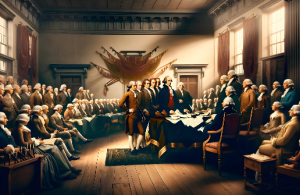 from the 13 colonies signing that document that forms the foundational covenant of America. In the Declaration we see their belief that man’s laws and rights should come from God. Britain’s denial of these rights caused the colonists to declare:
We hold these truths to be self-evident, that all men are created equal, that they are endowed by their Creator with certain inalienable rights, that among these are life, liberty and the pursuit of happiness.
The Declaration ends with the Congressional Representatives “appealing to the Supreme Judge of the World” and acknowledging “a firm reliance on the protection of Divine Providence.” We will see more of the Christian ideas contained within this document under the section on the National Archives.
Of the 56 men who signed the Declaration, all but two or three were orthodox Christians. Franklin was one who was unorthodox, but he was by no means anti-Christian — he acknowledged that “God governs in the affairs of men.” Some put Jefferson in this category, but at this time in his life there is nothing to indicate that he was anything but orthodox in his beliefs. Seven months after Jefferson drafted the Declaration, he started and financially supported the Calvinistical Reformed Church in Charlottesville, Virginia, that was pastored by an Evangelical minister, Charles Clay. Later, in 1803, he wrote “I am a Christian.”
The men who signed that document did so only after much thought and consideration. After all, they had more to lose than anyone in the colonies. They were the brightest minds, had the greatest talents, almost all were wealthy and many had large estates (some were the wealthiest in America), and most had families they loved dearly. In signing that document they did not see it as an avenue for fame, glory, or future advancement. They all knew they would be identified above all others by the British as the leaders of the “rebellion,” and consequently, those most likely to suffer retribution. They knew that “history was strewn with the bones and blood of freedom fighters.”25 They were up against the greatest military power on earth, and so faced a very real chance of losing everything.
They all suffered in some way. Virtually all the men had greater wealth before taking up the cause of liberty than afterwards. One writer summarizes the price the Signers paid:
Nine Signers died of wounds or hardships during the Revolutionary War. Five were captured or imprisoned, in some cases with brutal treatment. The wives, sons, and daughters of others were killed, jailed, mistreated, persecuted, or left penniless. One was driven from his wife’s deathbed and lost all his children. The houses of twelve Signers were burned to the ground. Seventeen lost everything they owned. Every Signer was proscribed as a traitor; every one was hunted. Most were driven into flight; most were at one time or another barred from their families or homes. Most were offered immunity, freedom, rewards, their property, or the lives and release of loved ones to break their pledged word or to take the King’s protection. Their fortunes were forfeit, but their honor was not. No Signer defected, or changed his stand, throughout the darkest hours. Their honor, like the nation, remained intact.26
These men have died and most have been forgotten by Americans today. It is sad that we have forgotten these founders of America, but it is tragic that we have forgotten the high price they paid for liberty — that liberty which we possess today, but may lose if we forget its great cost.
A few of those Christian signers include:
- John Hancock – As President of the Congress during the Revolution he issued many Proclamations for days of prayer, fasting, and thanksgiving. After the war he served as Governor of Massachusetts, where he issued many proclamations for days of prayer, like the one from October 15, 1791, which requests citizens to pray,
“That universal happiness may be established in the world; [and] that all may bow to the sceptor of our Lord Jesus Christ, and the whole earth be filled with His glory.”27
- Charles Thomson (1729-1804), Secretary of Congress from 1774-1789, retired from public life to translate the Scriptures from Greek to English. His 4 volume Bible was published in 1808 and is known for its accuracy and scholarship.
- John Dickinson (1732-1808), signer from Pennsylvania and author of first draft of the Articles of Confederation (1776), retired to write commentaries on the Gospel of Matthew. In his Last Will and Testament he wrote: “Rendering thanks to my Creator … to Him I resign myself, humbly confiding in His goodness and in His mercy through Jesus Christ for the events of eternity.”28
- John Witherspoon, minister and President of College of New Jersey, helped produce America’s first family Bible. He trained the men who shaped the nation.
- Charles Carroll of Carrollton built and personally funded a Christian house of worship. His writings show his strong Christian faith. (There is a statue of him in East Central Hall.) He wrote,
“On the mercy of my Redeemer I rely for salvation, and on His merits; not on the works that I have done in obedience to His precepts.”29
- Benjamin Rush started America’s first Bible society, through which America’s first mass-produced, stereotyped Bible was produced (the plates were imported in 1813 via help of President Madison and Congress). He declared,
“My only hope of salvation is in the infinite, transcendent love of God manifested to the world by the death of His Son upon the cross. Nothing but His blood will wash away my sins. I rely exclusively upon it. Come, Lord Jesus! Come quickly!”30
- Francis Hopkinson, church music director, was editor of one of the first hymnals printed in America (from 1767 ff). In this book he set all 150 Psalms to music so they could be sung. His hymnbook was one of the first books to place notes on a staff so that the melody could be seen and easily sung.
- Richard Stockton – As he was dying from hardships of captivity during the war, he put his affairs in order, writing in his last will and testament:
“As my children will have frequent occasion of perusing this instrument, and may probably be particularly impressed with the last words of their father, I think it proper here not only to subscribe to the entire belief of the great and leading doctrines of the Christian religion, such as the being of God; the universal defection and depravity of human nature; the Divinity of the person and the completeness of the redemption purchased by the blessed Savior; the necessity of the operations of the Divine Spirit; of Divine faith accompanied with an habitual virtuous life; and the universality of the Divine Providence; but also, in the bowels of a father’s affection, to exhort and charge [my children] that the fear of God is the beginning of wisdom, that the way of life held up in the Christian system is calculated for the most complete happiness that can be enjoyed in this mortal state, [and] that all occasions of vice and immorality is injurious either immediately or consequentially—even in this life.”31
- Thomas McKean — a signer of the Declaration, helped author the constitutions of Pennsylvania and Delaware, governor of each of these states, legal authority (writing Commentaries on the Constitution of the United States of America, 1792), Chief Justice of the Supreme Court of Pennsylvania — presided as Chief Justice over a trial where John Roberts was sentenced to death for treason. After delivering the sentence Chief Justice McKean gave this advice to Roberts:
“You will probably have but a short time to live. Before you launch into eternity, it behooves you to improve the time that may be allowed you in this world: it behooves you most seriously to reflect upon your past conduct; to repent of your evil deeds; to be incessant in prayers to the great and merciful God to forgive your manifold transgressions and sins; to teach you to rely upon the merit and passion of a dear Redeemer, and thereby to avoid those regions of sorrow—those doleful shades where peace and rest can never dwell, where even hope cannot enter. It behooves you to seek the [fellowship], advice, and prayers of pious and good men; to be [persistent] at the Throne of Grace, and to learn the way that leadeth to happiness. May you, reflecting upon these things, and pursuing the will of the great Father of light and life, be received into [the] company and society of angels and archangels and the spirits of just men made perfect; and may you be qualified to enter into the joys of Heaven—joys unspeakable and full of glory!”32
- Robert Treat Paine, Signer of Declaration, plainly expressed his faith in his will:
“I am constrained to express my adoration of the Supreme Being, the Author of my existence, in full belief of His providential goodness and His forgiving mercy revealed to the world through Jesus Christ, through Whom I hope for never-ending happiness in a future state.”33
[This article is from In God We Trust Tour Guide by Stephen McDowell, pp. 27-31]
- T.R. Fehrenbach, Greatness to Spare, The heroic sacrifices of the men who signed the Declaration of Independence, Princeton, NJ: D. Van Nostrand Co., 1968, p. 23.
- Ibid., p. 247.
- David Barton, A Spiritual Heritage Tour of the United States Capitol, Aledo, Tex.: Wallbuilders, 2000, p. 30. There is a statue of Hancock in the east corridor of the Senate wing of the Capitol.
- Quoted in, Stephen McDowell, America, a Christian Nation? Examining the Evidence of the Christian Foundation of America, Charlottesville: Providence Foundation, 2005, p. 21.
- Ibid, p. 21.
- Ibid., p. 21.
- Ibid., pp. 19-20.
- Ibid., pp. 23-24.
- Ibid., p. 20.