What Really Happened on July 4th

For PDF Version: What Really Happened on July 4th

By Stephen McDowell


During the first days of July in 1776 the Continental Congress was considering one of the most significant events of all time—the declaration by thirteen colonies to become the new nation of the United States of America.

On the issue of independence all the colonies were agreed, but a few of the most cautious delegates still were not sure about the timing. Rev. John Witherspoon, a delegate from New Jersey, answered their concerns as he said:
There is a tide in the affairs of men. We perceive it now before us. To hesitate is to consent to our own slavery. That noble instrument should be subscribed to this very morning by every pen in this house. Though these gray hairs must soon descend to the sepulchre, I would infinitely rather that they descend thither by the hand of the executioner than desert at the crisis the sacred cause of my country![1]

The delegates went on to approve the Declaration of Independence. After the announcement of the vote, silence moved over the Congress as the men contemplated the magnitude of what they had just done. Some wept openly, while others bowed in prayer. After signing the Declaration with unusually large writing, the President of the Continental Congress, John Hancock, broke the silence as he declared, “His majesty can now read my name without glasses. And he can also double the price on my head.”[2]

Adding to the solemnity of the tense moment, Hancock said, “We must be unanimous; there must be no pulling different ways; we must all hang together.” Benjamin Franklin responded in his characteristic wit, “Yes, we must indeed all hang together, or most assuredly we shall all hang separately!”[3]

On August 1, the day before an engrossed copy of the Declaration was signed (the copy now displayed in the National Archives in Washington, D.C.), Samuel Adams, whom men of that day ascribed “the greatest part in the greatest revolution of the world,”[4] delivered an address in which he proclaimed regarding the day of Independence: “We have this day restored the Sovereign to Whom alone men ought to be obedient. He reigns in heaven and… from the rising to the setting sun, may His kingdom come.”[5] The men who helped give birth to America understood what was taking place. They saw in the establishment of America the first truly Christian nation in history.

As Franklin suggested, they did “hang together,” but even so, many of these signers as well as tens of thousands of colonists lost their lives, families, reputations, and property in order to purchase liberty for themselves and their posterity.[6]

What was it that motivated these people to risk everything in order that they might have freedom? What was it that brought about the events leading to the colonists declaring their independence? John Adams, our second President and a leader in the cause of independence, revealed what he and many others thought as he wrote at the time that the colonies declared their independence:

It is the Will of Heaven, that the two Countries should be sundered forever. It may be the Will of Heaven that America shall suffer Calamities still more wasting and Distresses yet more dreadful. If this is to be the Case, it will have this good Effect, at least: it will inspire Us with many Virtues, which We have not, and correct many Errors, and Vices, which threaten to disturb, dishonor, and destroy Us. – The Furnace of Affliction produces Refinement, in States as well as Individuals…. But I must submit all my Hopes and Fears to an overruling Providence, in which, unfashionable as the Faith may be, I firmly believe.[7]

John Hancock echoed the reliance upon God and the belief that the destiny of nations is in the hand of God as he said:

Let us humbly commit our righteous cause to the great Lord of the Universe…. Let us joyfully leave our concerns in the hands of Him who raises up and puts down the empires and kingdoms of the earth as He pleases.[8]

Thomas Jefferson’s original draft of the Declaration of Independence contained a recognition of God, in particular: the laws of nature’s God, the existence of a Creator, the equality of all men before God, Creator-endowed rights,[9] and the purpose of government to protect the God-given rights of God-made man. However, the reliance upon God was so universally adhered to among those in America that the Continental Congress insisted it be made clear in this seminal document. When the draft of the Declaration was debated before Congress, they added the phrase, “appealing to the Supreme Judge of the World, for the rectitude of our intentions,” as well as the words “with a firm reliance on the protection of divine Providence.”[10] Thus, we see the Continental Congress declaring to the entire world their Christian convictions.

Not only does the Declaration of Independence reflect our Founders’ faith in God, but this document only came into being as a result of Biblical ideas that had been sown in the hearts of the colonists for over one hundred and fifty years. The American Revolution was a revolution of ideas long before it was a revolution of war. As the clergy and other leaders taught the colonists their God-given rights as men, Christians, and subjects, the inevitable result was a nation birthed in liberty.

Samuel Adams recognized the importance of educating everyone throughout the colonies so that they could reason out their rights and political convictions based upon Biblical principles. For this reason he began establishing “Committees of Correspondence” in 1772.[11] His desire was for the colonists to be united “not by external bonds, but by the vital force of distinctive ideas and principles.”

This unity of ideas and principles helped to promote union among the colonists. The common ideas sown within the colonists’ hearts by Samuel Adams and many other Christian thinking men of that and earlier generations, resulted in the Declaration of Independence and the external union of the colonies into the United States of America.

Our celebration of the birth of the nation on July 4th must surely place God at the center, for without His guiding hand our nation would have never come into being. As did the Founders of this nation, so should we recognize this fact. John Adams wrote that the day of independence “will be the most memorable Epocha, in the History of America.—I am apt to believe that it will be celebrated, by succeeding Generations, as the great anniversary Festival. It ought to be commemorated, as the Day of Deliverance by solemn Acts of Devotion to God Almighty … from one End of this Continent to the other from this Time forward forever more.”[12]


[1] Samuel Davies Alexander, Princeton College During the Eighteenth Century (New York: Anson D.F. Randolph & Co.), p. ix.

[2] This is an anecdotal story reported by many sources using varying terminology. This quote is in Robert Flood, Men Who Shaped America, Chicago, 1968, p. 276. Another records Hancock said: “There, I guess King George will be able to read that” (The Annals of America, Vol. 2, Chicago: Encyclopedia Britannica, 1968, p. 449). This and the other comments could have been made on July 4 or perhaps on August 2 when the engrossed copy was signed by most of the delegates.

Jefferson records that on July 4 the Declaration was “signed by every member present, except Mr. Dickinson” (The Autobiography of Thomas Jefferson in The Life and Selected Writings of Thomas Jefferson, ed. Adrienne Koch and William Peden, New York: The Modern Library, 1944, p. 21). Historian Benson Lossing concurs, writing that after approving the Declaration all the delegates signed their names on a paper that was attached to a copy of the Declaration (Benson J. Lossing, Our Country, A Household History of the United States, New York: James A. Bailey, 1895, Vol. 3, p. 871). However, some people do not think that the delegates signed on this day (citing various indirect remarks from delegates, in addition to the fact that such an original copy of the signees is not known to exist), but rather that all would not sign until an engrossed copy was made. Soon after approval of the Declaration on July 4, with the oversight of the committee, printer John Dunlap prepared and printed copies, perhaps during the night of July 4, which were sent to the governors of several states and to the commanding officers. These broadsides were authenticated by the signatures of John Hancock, the President, and Charles Thomson, the Secretary. On July 19 the Congress ordered the Declaration engrossed on parchment (Julian P. Boyd, The Declaration of Independence, The Library of Congress, 1999, p. 36). This engrossed copy was signed by 54 delegates on August 2 and two others afterward, one in September and the other later in the autumn (Lossing, Our Country, A Household History of the United States, Vol. 3, p. 871).

[3] The Annals of America, Vol. 2, Chicago: Encyclopedia Britannica, 1968, p. 276.

[4] George Bancroft, History of the United States, Boston: Little, Brown, and Co., 1878, Vol. VI, p. 355.

[5] Samuel Adams, An Oration Delivered at the State-House, in Philadelphia, to a Very Numerous Audience; on Thursday the 1st of August, 1776; London, reprinted for E. Johnson, No. 4, Ludgate-Hill, 1776. See also Frank Moore, American Eloquence: A Collection of Speeches and Addresses, New York: D. Appleton & Co., 1858, Vol. 1, p. 324. (Some historians do not think Adams made these remarks, but even if this is so, the content is consistent with his beliefs and writings.)

[6] These men were prepared to give their lives for the cause of liberty, and thought this was a very real possibility. Signer Benjamin Rush would later write to signer John Adams: “Do you recollect your memorable speech upon the day on which the vote was taken? Do you recollect the pensive and awful silence which pervaded the house when we were called up, one after another, to the table of the President of Congress to subscribe what was believed by many at that time to be our own death warrants?” (Letter of Benjamin Rush to John Adams, July 20, 1811, Letters of Benjamin Rush, edited by L.H. Butterfield, Vol. 2: 1793-1813, Princeton University Press, 1951, pp. 1089-1090.)

[7] The Book of Abigail and John, Selected Letters of the Adams Family, 1762-1784, ed. L.H. Butterfield, March Friedlaender and Mary-Jo Kline, Cambridge, Mass.: Harvard University Press, 1975, p. 140. Letter from John to Abigail Adams, July 3, 1776.

[8] John Hancock, “Oration, Delivered at Boston, March 5, 1774,” in Hezekiah Niles, Principles and Acts of the Revolution in America, New York: A.S. Barnes & Co., 1876, p. 42.

[9] Jefferson’s original wording for this point was, “that all men are created equal and independent; that from that equal Creation they derive Rights inherent and unalienable.” The committee assigned to oversee the drafting of the Declaration changed it to, “that all men are created equal, that they are endowed by their Creator with certain unalienable rights.” See Julian P. Boyd, The Declaration of Independence, Washington: The Library of Congress, 1999, pp. 31, 60.

[10] See Julian P. Boyd, The Declaration of Independence, p. 35.

[11] See William V. Wells, The Life and Public Service of Samuel Adams, Boston: Little, Brown, and Company, 1865, Vol. 1.

[12] Letter from John to Abigail, July 3d. 1776, in The Book of Abigail and John, Selected Letters of the Adams Family, 1762-1784, p. 142. The Congress voted on July 2 for independence, while they approved the Declaration of Independence (which states the reasons for their action) on July 4. Adams was referring to the July 2 vote in this letter to Abigail.
Patrick Transforms a Nation: An Example for Today

By Stephen McDowell


[This article is excerpted from the book Biblical Revival and the Transformation of Nations by Stephen McDowell. Visit our Store to order a copy.]


Can a nation be transformed?

America is obviously in need of Biblical transformation, as are all the nations of the world. But can we really expect such transformation to ever occur? Can God’s Kingdom come to earth and His will be done here as it is in heaven? Can a nation experience Biblical transformation in our lifetime?

First, since Jesus taught us to pray for this, we can have assurance it can occur. Jesus also gave us the commission to disciple the nations (Matthew 28:18-20), as this is a part of His plan for man while living on earth. In addition, there are many examples in history. Perhaps the greatest example of how Biblical revival transforms nations occurred in the fifth through the seventh centuries, beginning when a young Celt was carried to Ireland as a slave.

Patrick of Ireland was an outstanding example of a man who discipled a nation. He was a world figure; one of the very great among men; “one of the dominant personalities of world history.”[1] He completely transformed Ireland in his lifetime and set the nation on its destiny. His work in Ireland was a world event. Historian Seumas MacManus writes:

All histories of all countries probably could not disclose to the most conscientious searcher another instance of such radical change in a whole nation’s character being wrought within the lifespan of one man.[2]

There was a complete transformation of Ireland from the time before and after Patrick. The people before Patrick were worshiping idols and “were carrying the ruthless law of the sword far over sea and land” enslaving those they encountered. After Patrick, the worship of the living God was predominant throughout the nation, and the Irish people “left the conquering sword to be eaten by rust, while they went far and wide again over sea and land, bearing now to the nations— both neighbouring and far off— the healing balm of Christ’s gentle words.”[3]

Patrick’s providential preparation is an amazing story. Around the year 389 A.D., at the age of 15 or 16, Patrick was captured and enslaved by Irish marauders. He spent six years as a slave in Ireland during his impressionable years. He learned the language, religion, and culture and became an Irishman in many ways. Most importantly, he was converted, remembering his Christian upbringing, and had the seeds of his life work planted in him. His life of a shepherd gave him much time to pray and seek God. He eventually escaped Ireland, acting upon a vision from the Lord, and would not return for over 35 years.[4]

Patrick was about 58 years old when God sent him back to Ireland to fulfill his destiny. His work for the next 28 years brought about as great a transformation in a nation as any man has ever wrought during his lifetime.

The foundation of his life work, and what is needed to transform nations today, was laid in Patrick while he was a slave in Ireland. Brought up in a Christian home, as a youth Patrick had forgotten God and wandered into the ways of sin, but he was awakened unto God. He writes in his Confessions, “And there the Lord opened the understanding of my unbelief so that at length I might recall to mind my sins and be converted with all my heart to the Lord, my God, who hath . . . taken pity on my youth and ignorance.”[5]

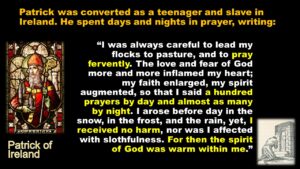
Patrick had much time to pray while he watched the flocks day and night, writing:

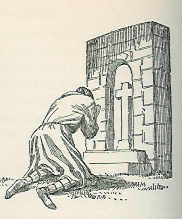
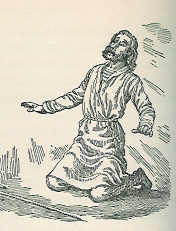
I was always careful to lead my flocks to pasture, and to pray fervently. The love and fear of God more and more inflamed my heart; my faith enlarged, my spirit augmented, so that I said a hundred prayers by day and almost as many by night. I arose before day in the snow, in the frost, and the rain, yet, I received no harm, nor was I affected with slothfulness. For then the spirit of God was warm within me.[6]

Patrick spent over six years in slavery, where he was first miraculously delivered from spiritual bondage and then from physical bondage. In a dream he was told to travel to a seashore some 200 miles away where he would find a ship to make his escape. He slipped away one day and found the ship as in his dream. God used his time of captivity to prepare him for his destiny. He had surrendered his life to the Lord and had become an Irishman. During his impressionable years, he had learned the language and customs of Ireland and had a deep love for the people implanted in his heart through his continued times of prayer in the countryside.

Upon returning to Britain, he was happily reunited with his family, but Ireland filled his thoughts. He was not sure what this meant, until one night he had a vivid dream of a man coming from Ireland delivering a message from the people there saying, “Come to us, O holy youth, and walk among us.” Patrick said, “With this I was feelingly touched, and could read no longer: I then awoke.”[7]

He now knew he must prepare himself, so he left home to study for the ministry. During the next number of decades he traveled to many parts of Europe to gain what training he could. Finally, around the age of 58 he reached Ireland in 432 A.D. in the fourth year of the reign of Laoghaire.

He encountered much opposition and difficulties, but he saw God move miraculously on his behalf. He first landed near Vartry in Wicklow County, where he preached and baptized some but was then driven out. He went north and landed in Down where he was attacked by Dichu, who, upon seeing and hearing Patrick, lowered his arms and surrendered his life to God. Patrick later built a church upon this spot, called Sabhall Padraic, to commemorate his first convert in the north.

Patrick traveled throughout the land bringing Christ to all who listened. Many were converted and followed him, including a young lad named Benin, who would come to fill Patrick’s place as leader in the church and head of the school of Armagh, one of many established to train new leaders. Benin would also write the great and valuable Book of Rights.

Early on, Patrick challenged the pagan worship of the Irish. After violating the tradition of lighting a fire before the Druid priests lit their sacred fire, Patrick and his followers were compelled to appear before the pagan King Laoghaire. As they marched toward the king’s court, the Druid minions lay in ambush to kill them. Patrick had composed a prayer or hymn that the missionaries chanted on the way. This was later called Faed Fiada, or Deer’s Cry, for when Patrick and his companions walked by those who were hiding, they did not see men, but “a harmless herd of gentle deer, a doe followed by her twenty fawns.” Thus, they arrived safely at the king’s court in Tara.

This first hymn written in Gaelic has been used down throughout the years by the Irish as a prayer of protection.

Patrick’s Prayer/Hymn – Deer’s Cry

I bind me to-day,

God’s might to direct me,

God’s power to protect me,

God’s wisdom for learning,

God’s eye for discerning,

God’s ear for my hearing,

God’s word for my clearing.

God’s hand for my cover,

God’s path to pass over,

God’s buckler to guard me,

God’s army to ward me,

Against snares of the devil,

Against vice’s temptation,

Against wrong inclination,

Against men who plot evil,

Anear or afar, with many or few.

Christ near,

Christ here,

Christ be with me,

Christ beneath me,

Christ within me,

Christ behind me,

Christ be o’er me,

Christ before me.

Christ in the left and the right,

Christ hither and thither,

Christ in the sight,

Of each eye that shall seek me

In each ear that shall hear,

In each mouth that shall speak me –

Christ not the less,

In each heart I address

I bind me today on the Triune — I call,

With faith in the Trinity – Unity – God over all.[8]


Patrick was confronted by the Druid priests who sought to use their magic to overpower him. But God performed such miracles through Patrick, and his words were of such wisdom, that many began to be converted, including the queen and several prominent members of the court. While Laoghaire remained a pagan, he, nonetheless, was so moved by Patrick that he allowed him to travel throughout his domain and preach to whom he wished.

Patrick went into other parts of Ireland, dispelling the darkness with the light of the Gospel, making many converts, including King Laoghaire’s two daughters. His influence grew mightily, to the point where all the serpents and venomous things were driven out of Ireland, which is true spiritually more so than physically. (While there are no snakes in Ireland, this was probably the case before Patrick arrived.[9])

Over the years, thousands of people were converted including many kings and leaders of the people. “An unquenchable burning desire for bringing souls to Christ was the passion of Patrick’s life.”[10] In addition to multitudes of converts, Patrick worked to bring transformation in all spheres of life:

  • He saw untold thousands converted.
  • He founded 700 churches.
  • He trained and set in place Church leadership — 700 bishops and 3000 ministers.
  • He set up training centers to educate thousands.
  • He transformed civil government, working with kings to establish godly laws. He wrote the Liber Ex Lege Moisi, which were extracts from the Laws of Moses. He directed the compilation of the laws known as Senchus Mor, revising old laws in accordance with Biblical precepts. Liber and Senchus Mor became the basis for civil law in Ireland.


“He worked so many miracles and wonders, that the human mind is incapable of remembering or recording the amount of good which he did upon the earth.”[11] He carried on his nation-changing work with great confidence in the Lord, but with great humility, writing in his Confessions, “I was a stone, sunk in the mire till He who is powerful came, and in His mercy, raised me up.”[12]

After saving the life of a local chief, Patrick was given the Hill of Armagh in thanks. Here he founded the city of Armagh which became the center for Christian training that would impact all of Europe. Within a few centuries the work and schools of Armagh would grow to the point where the place would become “not only the ecclesiastical capital of Ireland but the capital of civilisation.”[13] Being advanced in years, Patrick placed Benin over the church and school of Armagh.

In his later years Patrick directed, as mentioned above, the compilation of the laws known as Senchus Mor. He revised the old laws in accordance with Biblical precepts. These laws were also known as the Brehon Laws (from the Irish name of the official lawgiver). He also wrote his famous Confession and other works, which still inspire people today. He died around the year 460, but his work would impact Ireland and all of Europe for centuries to come.

Fruit of Patrick’s Work Transformed a Continent

Many other nations were impacted through those who were trained in the churches, seminaries, and schools Patrick started. Many holy men and women continued Patrick’s work. The three greatest Irish saints were Patrick, Bridget and Colm Cille (Columba).

In the centuries succeeding Patrick, Christians swarmed forth, like bees from a hive, from the Irish monasteries and schools to distant lands carrying the faith and truth that brought many people out of barbarism. One historian wrote: “It was thus, when the whole world seemed irrecoverably sunk in barbarism . . . the Irish went forth into every part of the world,” to spread Christianity and knowledge.[14]

The barbarians (Vandals, Huns, Franks, Visigoths, Saxons, Angles, Jutes, etc.) swept through Europe in the 400s, conquering and destroying all before them. The light of the Gospel in much of Europe was threatened to be extinguished. It was at this crucial time that the fruit of the work of Patrick in Ireland began to grow. One modern book’s title describes the influence: How the Irish Saved Civilization. Carrying Christianity, Ireland’s sons “became the teachers of whole nations, the counsellors of kings and emperors.”[15] In addition, Christians from all over England and Europe flocked to Ireland to be trained in the Holy Scriptures, only to return to their lands to sow all that they had learned.


[To learn of the impact of Patrick’s work as well other reformers throughout history, order a copy of Biblical Revival and the Transformation of Nations via our online Store or calling 434-978-4535.]


End Notes

[1] Seumas MacManus, The Story of the Irish Race, New York: The Devin-Adair Co., 1967, p. 124.

[2] Ibid., p. 126.

[3] Ibid.

[4] See MacManus, pp. 111 ff.

[5] Ibid., p. 120.

[6] Ibid., p. 110.

[7] Ibid., p. 111.

[8] Ibid., p. 114.

[9] Ibid., p. 117.

[10] Ibid., p. 126.

[11] Ibid., p. 124.

[12] Ibid., p. 126.

[13] Ibid., p. 118.

[14] Dr. Wattenback, quoted in Ibid., p. 232.

[15] Ibid., p. 232.